
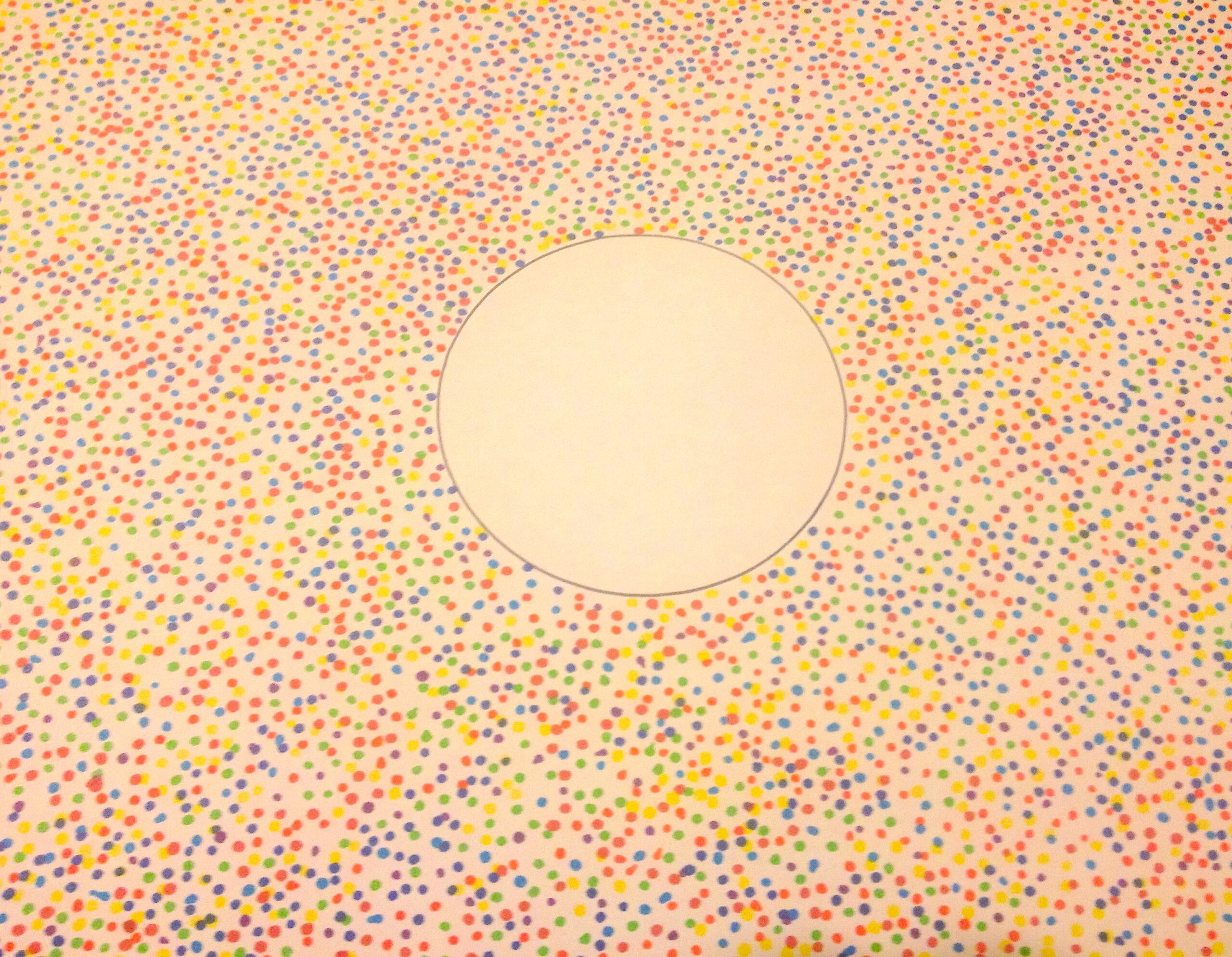
One evening, after a long day, I found myself mentally overloaded—thoughts racing, ideas colliding, my mind buzzing in too many directions at once. I decided to return to something I used to do as a child—drawing.
There was something about putting pen to paper that felt grounding, a way of translating the tangle of thoughts into something more tangible. I once met a monk on a plane and he described drawing as a form of meditation, a way to settle the mind without needing to empty it.
So, I drew.
For three hours, I let my pen move across the page. And when I stepped back, I realized: this was a drawing of my mind.
Drawn by hand, it took me 3 hours
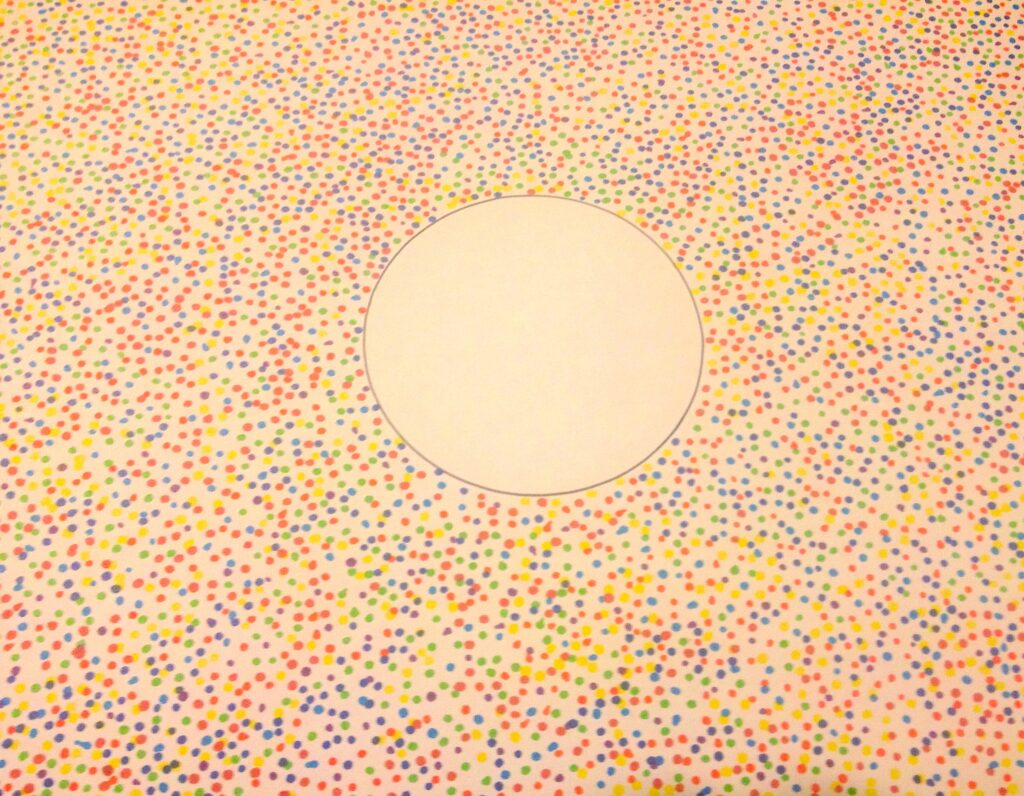
- The outer dots – These scattered, chaotic dots represent the competing thoughts, ideas, and distractions pulling my attention in different directions.
- The inner circle – This space symbolises the stillness and clarity I always seek—a place where my thoughts feel ordered, where focus comes easily.
- The wall or membrane – This barrier is the mental effort it takes to keep the noise at bay. Sometimes it holds firm, sometimes it doesn’t.
Looking at it afterward, I could see exactly how I’d been feeling. Overstimulated, a little trapped, but craving calm.
The more I create, think, and explore ideas, the more I realise I also need moments of stillness.
There’s a familiar feeling that comes after completing a big task or spending time outside in fresh air—that moment when everything feels lighter, simpler, more in balance.
And then there’s the opposite—when my mind is cluttered, overflowing with ideas but too jumbled to act on any of them. I get caught in an endless loop of:
💭 Too many ideas
💭 Not knowing where to start
💭 Feeling overwhelmed and doing nothing
It’s a common cycle. I know many creative people experience it—the way the mind works faster than we can keep up with, bombarding us with connections, insights, and possibilities.
I’ve heard psychologists describe it as the hallmark of a prolifically creative mind—the ability to think deeply, to connect seemingly unrelated ideas, to see the world from unique angles.
But I’ve also learned that, like anything, it has a flip side.
🔆 Too much thinking can become paralysis.
🔆 Too many ideas can lead to inaction.
🔆 A scattered mind, left unchecked, can create frustration instead of fulfilment.
Because when we allow our minds to breathe, the clarity always finds its way back.
How to Find Mental Clarity
These are a few things that have helped me when my mind feels chaotic. They might not work for everyone, but I’ve found them useful:
✍️ Writing things down – Getting thoughts onto paper often helps me see them more clearly. Even just scribbling ideas randomly can be enough to feel some relief.
🗣️ Talking things through – I’ve noticed that saying things out loud (especially with someone who understands my way of thinking) helps untangle the mess in my head.
🌿 Stepping away from it all – Going for a walk, moving my body, or doing something non-verbal sometimes lets my thoughts settle naturally, without me trying to force it.
✅ Sorting through ideas slowly – Instead of pressuring myself to act on everything at once, I try to capture ideas somewhere and return to them later when I have more clarity.
A Work In Progress
I don’t think I’ll ever be someone with a perfectly organised mind—I’ve accepted that. But I’ve also realised that it’s not about shutting down the chaos—it’s about learning to work with it.
So when things feel overwhelming, I remind myself:
🔆 Let the thoughts come.
🔆 Capture them if they feel important.
🔆 Give them space to rise and settle.
When I allow my mind to breathe, the clarity always finds its way back.
What Works For You?
- Do you experience mental clutter like this?
- How do you regain clarity when your mind feels chaotic?
- What helps you turn overwhelm into action?
I’d love to hear your thoughts.
~ Andy
Related Posts
Andy’s 7 Step Guide To Running Hackathons
Introduction Thirteen years ago, I ran into my very first hackathon at the Global Service Jam in Newcastle, 2012. I…

Bringing Leadership to Life: The Power of Creative Profiles
As part of a recent consultancy project, I had the privilege of helping an organization build a stronger global leadership community. With hundreds of leaders…
Life Beat Course in Creative Facilitation
Expanding My Facilitation Toolkit Through Play, Creativity & Connection At the end of 2024, I lept into the world of LIFEbeat, many years…