
Andy's Blog
The Power of Visual Thinking: How To Improve Your Communication Skills

The first time I truly understood the importance of visual thinking was teaching a Service Design summer school at Central St. Martins.
It struck me how often people resist drawing, recalling school art lessons where they were made to feel they weren’t good enough. But what if drawing wasn’t about being an artist? What if it was simply a tool—one that could transform communication and problem-solving
For me, drawing and visualising does comes naturally as I’m a very visual thinker—however, I utilise visual thinking way more often than I do drawing for art or design reasons.
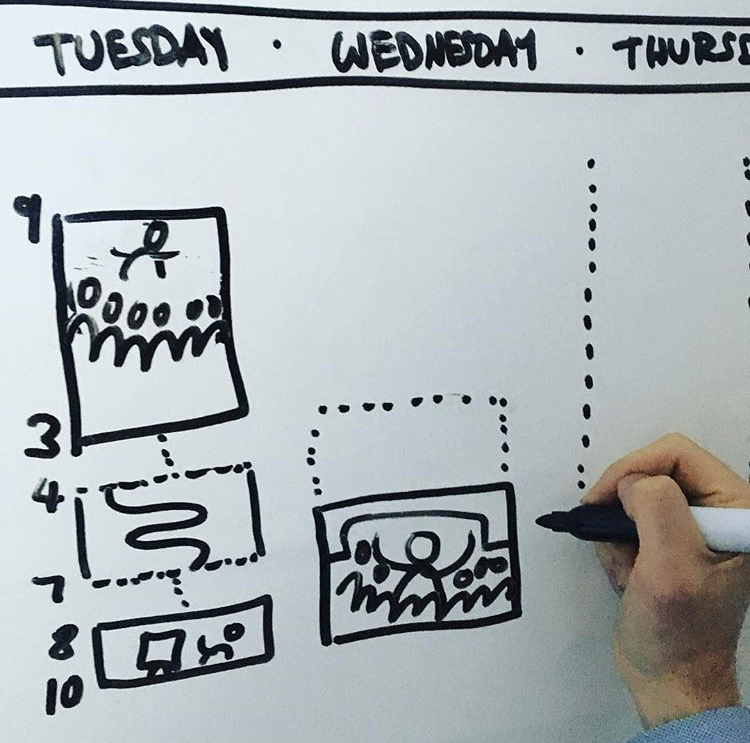
It’s an essential part of how I process ideas, communicate concepts, and solve problems.
Why Visual Thinking Matters
Drawing and visualisation help clarify and align ideas, especially in creative problem-solving. Here’s why:
- Clarify Abstract Ideas 🧩
Complex concepts can be hard to explain with words alone. A simple diagram can make them instantly clearer. - Align Mental Models 🔄
People may visualise ideas differently in their heads. A sketch ensures that everyone is on the same page, reducing misunderstandings. - Enhance Memory and Retention 🧠
Studies show that visuals are easier to remember than spoken or written words alone, making meetings more productive. - Encourage Creative Thinking 🎨
Drawing forces the brain to think in new ways, helping uncover fresh solutions. - Simplify Complex Information 📊
Flowcharts, mind maps, and simple sketches break down complicated processes into digestible parts. - Bridge Language and Cultural Barriers 🌍
A drawing can communicate ideas universally, making collaboration smoother in diverse teams. - Spark Discussion and Iteration 💬
A rough sketch invites feedback and refinement, encouraging teams to co-create solutions. - Engage Both Sides of the Brain 🤹
Drawing activates both the logical and creative sides of the brain, fostering deeper problem-solving. - Make Meetings More Dynamic ⚡
Rather than long-winded explanations, quick sketches keep discussions focused and interactive. - Encourage Participation 🙌
When people feel empowered to visualize their thoughts, problem-solving becomes more inclusive.
Visual thinking is about clarity, collaboration, and creativity.
Overcoming the Fear of Drawing
One of the biggest obstacles to visual thinking is the internal belief that “I can’t draw” or “I’m not creative.” But the goal isn’t to create a masterpiece—it’s to communicate. Stick figures, simple shapes, arrows, and rough diagrams are often enough to get an idea across.

In team meetings and problem-solving sessions, visual thinking is an invaluable skill, especially for leaders and managers. While conversations and discussions are essential, adding a visual layer makes meetings more inclusive, engaging, and effective. Yet, so many people hesitate to draw, convinced that they “can’t draw” or that their sketches won’t be good enough. The truth is, it doesn’t need to be great—it just needs to communicate clearly.
The key is to shift the mindset from artistic perfection to effective communication.
Applications of Visual Thinking
Visual thinking can be applied in countless ways across industries and roles, including:
- Re-modelling Processes – Mapping out workflows to identify bottlenecks and inefficiencies.
- Designing Systems – Creating diagrams to understand how different components interact.
- Strategic Planning – Visualising goals, timelines, and dependencies in an accessible format.
- Facilitating Meetings – Using sketches to summarise discussions and next steps.
- Product & Service Design – Storyboarding user journeys to improve customer experiences.
Top Tip
Use Chunky pens, they can help you focus less on the details and more on the essence of the visual image you’re making.
Final Thoughts
If you can get past the idea that you “can’t draw” and instead focus on how sketching can be a valuable communication tool, you unlock a new dimension of problem-solving.
So next time you’re in a meeting, grab a pen and sketch out your thoughts. You might be surprised at how much it transforms the conversation.
Here’s to less boring meetings and more dynamic conversations!
~ Andy
Related Posts
Andy’s 7 Step Guide To Running Hackathons
Introduction Thirteen years ago, I ran into my very first hackathon at the Global Service Jam in Newcastle, 2012. I…

Bringing Leadership to Life: The Power of Creative Profiles
As part of a recent consultancy project, I had the privilege of helping an organization build a stronger global leadership community. With hundreds of leaders…

Life Beat Course in Creative Facilitation
Expanding My Facilitation Toolkit Through Play, Creativity & Connection At the end of 2024, I lept into the world of LIFEbeat, many years…