
Andy's Blog
The 5 Hidden Barriers Holding Freelancers Back (And How to Overcome Them)

As freelancers and creative professionals, we don’t have a boss, a team, or a rigid structure keeping us on track. This freedom is exciting—but it also means that our success (or failure) depends entirely on us – and how we work with clients of course.
Without clear direction, it’s easy to struggle with inconsistency, burnout, or stagnation. I know because I’ve been there, particularly early in my freelance life. And if you’ve ever felt stuck in your career, this ‘Freelancer Dysfunction Pyramid might explain why—and help propel your forward. This is an adaption from the brilliant work of Patrick Lencioni.
As I do a lot of work with high-level leadership, concept like the 5 Dysfunctions of a Team are highly valuable, however, as I unpacked it, it made me think about a version for freelancers. Whilst there are a lot of factors outside of our control, enhancing the parts we can influence is key, starting with ourselves.
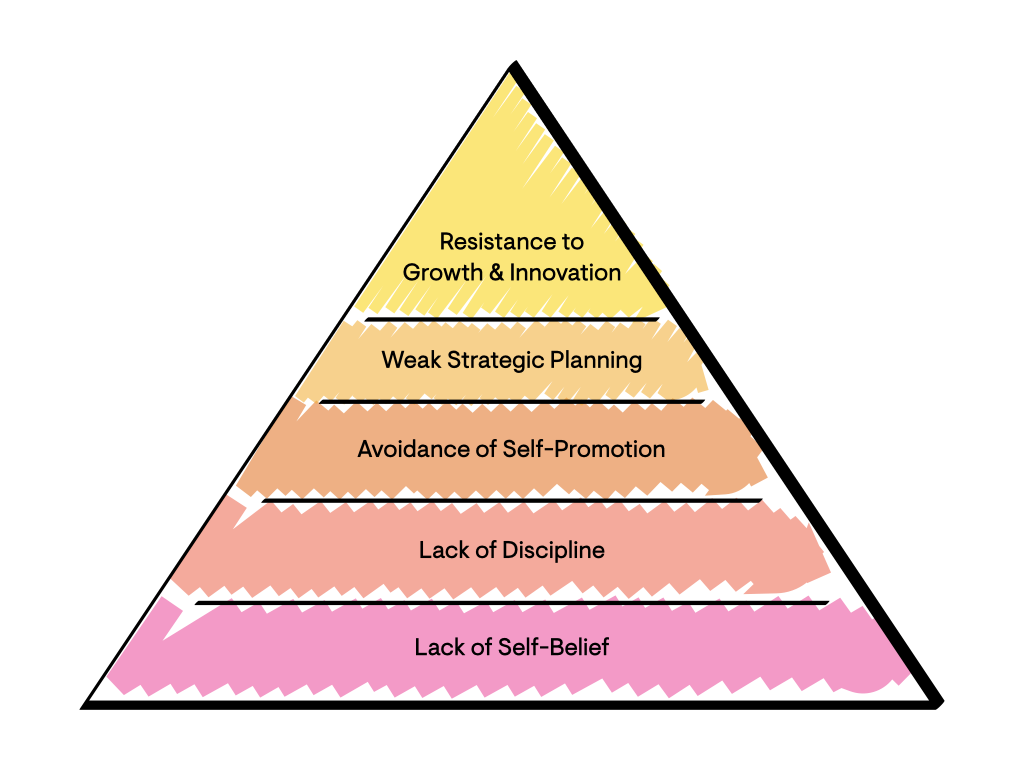
1. Lack of Self-Belief (The Foundation)
At the base of everything is self-belief. If we don’t trust in our own skills, value, or ability to succeed, we hesitate to take action. Imposter syndrome creeps in, leading to procrastination, low pricing, or avoiding opportunities altogether.
Signs we struggle with self-belief:
- We frequently compare ourselves to others and feel inadequate.
- We undercharge or hesitate to raise our rates.
- We avoid calling ourselves “professionals” or feel like frauds.
How we can enhance it:
- Keeping a success journal to track wins, client feedback, and progress.
- Challenge negative self-talk with evidence-based thinking (reminding myself of my real skills and accomplishments).
- Surround myself with supportive peers and mentors who reinforce my value.
2. Lack of Discipline
Even when we believe in ourselves, without discipline, nothing gets done. I used to resist structure, thinking creativity thrives in chaos—but in reality, consistency and systems are what allow creativity to flourish.
Signs we struggle with discipline:
- We procrastinate, miss deadlines, or struggle to focus.
- Our work schedule is erratic, and we often feel overwhelmed.
- We lack a system for tracking projects, invoices, or client communication.
How we can enhance it:
- Set working hours (even if they’re flexible) and block out your calendar .
- Use productivity techniques like Pomodoro timers, bond sessions, batching tasks, or setting deadlines even when clients don’t.
- Treat my creative business as a real job—because it is.
3. Avoidance of Self-Promotion
The best work in the world won’t get noticed if no one knows we exist. I used to avoid marketing because it felt like bragging or being “salesy.” But I’ve learned that self-promotion is about helping people find the value we offer.
Signs we struggle with self-promotion:
- We rely only on word-of-mouth instead of actively marketing.
- We cringe at the idea of posting about our work online.
- We don’t follow up with past clients for testimonials or referrals.
How we can enhance it:
- Shifted your marketing mindset, for example: Marketing = helping people and solving problems.
- Develop a simple plan (e.g. one social post per week, one event per month, one newsletter – something is better than nothing at all).
- Play to your strengths in your approach and recognise the need to step out of your comfort zone to do what the market or your target audience need
4. Weak Strategic Planning
For a long time, I took on any work that came my way without thinking long-term. This led to overwork, underpricing, and burnout. Without a clear strategy, we can find ourselves stuck in a cycle of feast-or-famine work, clinging onto hope that it will somehow just get better.
Signs we struggle with strategic planning:
- We say “yes” to everything, even low-paying gigs.
- We don’t have clear pricing or a financial goal.
- We don’t know where we want our career to be in 1-3 years.
How we can enhance it:
- Create targets or income goals and price your work accordingly.
- Set filters for accepting projects (e.g., “Does this align with my skills and growth goals?”).
- Work with a coach or strategist or can offer pragmatic and strategic thinking
5. Resistance to Growth & Innovation (The Peak)
Once self-belief, discipline, marketing, and strategy are in place, the final challenge is staying adaptable. Many of us get comfortable and stop learning, which leads to stagnation in a rapidly changing creative landscape.
Signs we struggle with growth:
- We avoid learning new skills or updating our portfolio.
- We feel like our work has plateaued.
- We’re resistant to industry trends or new technology.
How we can enhance it:
- Dedicate time for skill development (taking online courses, attending workshops).
- Experiment with new creative styles, tools, or services.
- Stay connected to communities, mentors, and trends in my field.
I hope this helps you identify what’s holding you back and gives you some practical steps to move forward. Breaking through these dysfunctions doesn’t happen overnight—but awareness is the first step. If you recognize yourself in any of these levels, don’t get discouraged. Start by tackling the foundation first (self-belief), then work your way up.
Creative freelancing is about more than just talent—it’s about mindset, habits, and strategy. The good news? All of these skills can be learned.
I’d love to hear from you—which level do you relate to the most? And if you’d like coaching or further support in navigating these challenges, feel free to get in touch. I’d love to help!
If you want to watch the origin if this concept, Five Dysfunctions of a team, here it is.
Related Posts
Andy’s 7 Step Guide To Running Hackathons
Introduction Thirteen years ago, I ran into my very first hackathon at the Global Service Jam in Newcastle, 2012. I…
Life Beat Course in Creative Facilitation
Expanding My Facilitation Toolkit Through Play, Creativity & Connection At the end of 2024, I lept into the world of LIFEbeat, many years…

Books I Read In 2024
As 2024 comes to a close , I thought I’d reflect on the books I’ve read or listened to this year. *This isn’t a marketing or…